(I feel like I spend quite a lot of time on trains on my own. This was between London and Grantham, it was an exercise in ...something. Inconsistency and repetition, mostly. I kind of find it funny.)
Yellow line painted along the edge of a platform,
Yellow sign at the entrance to a tunnel as we leave it
Another line along a platform,
a salt and grit bin,
a tariff sign in a car park
some ragwort flowers
more ragwort
McDonalds and Subway signs,
another platform line, more car park signs
ragwort again
platform line
ragwort.
Paintwork on a train going in the other direction,
some graffiti under a bridge, a sign at a junction
a flag outside a showroom,
a sign on the door of an electricity terminal
Ragwort.
Another passing train, another platform line, more ragwort,
some machinery at the side of the track
Ragwort,
a field of ragwort.
Platform edge, again.
Ragwort,
a sign by the side of the track with a number 25 on it,
some fencing at a building site, the end of a passing train, the back of an ambulance.
Car parking barriers.
The roof of a children's push along car on a balcony.
Some flowers in a allotment,
number plates outside a car showroom, graffiti.
Another train.
Platform edge at Hitchin.
Some reels of cable at the side of the track.
Some crash barriers in a car park, the edge of a road sign, some stacked skips.
A sign with a number 34 on.
A metal frame around the top of a pick-up truck,
a burglar alarm on a house,
platform edge,
reflective stripes on a service vehicle,
a sign with a number 37 on,
ragwort.
Some paint on a telegraph pole.
Number plates on a housing estate,
platform egde,
burglar alarm.
Emergency telephone next to the track,
Signs at a sewage works,
ragwort.
Showjumping fences.
Ragwort, graffiti,
signs on some warehouses, numbering doors.
Warning signs at the base of a pylon,
another number.
Ragwort.
A road sign.
Writing on a sign for a builders' merchants, platform edge, ragwort, train end ragwort.
Yellow cover over a trailer.
Yellow box thing,
van at a level crossing,
ragwort,
bollards on a traffic island, graffiti under a bridge,
ragwort.
Platform edge.
Road markings,
piles of plastic tubing.
Graffiti, ragwort, graffiti, ragwort.
Passing train.
Signs on telegraph poles,
something on top of a block of concrete,
ragwort, salt and grit bin, ragwort.
More parked machinery.
Salt and grit bin, writing on lorries, entrance to a warehouse,
a bit of yellow plastic.
Danger of death sign,
graffiti,
danger unsafe roof sign on some garages,
end of another train, another sign about electrocution.
Kwik-Fit sign,
notices on a multi-storey car park,
a yellow car,
paint on the rails.
No trespassing sign on a building site,
burglar alarm, CCTV sign in a station car park, rear number plates, a yellow car.
A man with a yellow shirt on a billboard.
The handrail on the way out of Peterbrough station, a painted barrier, a salt and grit bin.
The back of a parked fire engine,
car park barriers,
stripes on a Network Rail building.
Parked freight trains, paint on a lamp post.
A generator and a floodlight,
more freight trains,
vehicles on a building site.
A blind in a window,
a house painted yellow.
Stripes on post office lorries.
Danger sign at a level crossing,
ragwort,
danger sign at a level crossing.
Number plates at a caravan site, a Jet station,
a crane.
Ragwort.
A danger sign at a power station.
Ragwort.
Tuesday, 20 July 2010

Tuesday, 25 May 2010
Augmented reality.
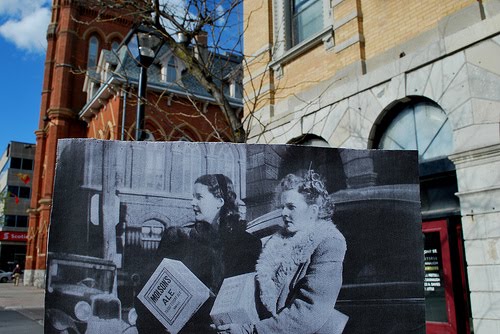
There are things along similar lines to what I have been doing happening on a slightly larger scale...
The first image is from a group on Flickr called Looking into the Past, which uses old photos of places inside recent ones, and the second is an image from an iPhone app launched by the Museum of London called StreetMuseum, which does a similar thing, combined with geotagging, to map images of the past from its photographic archives, onto streets in the present.

The resulting images are so direct that I do wonder if I should've done something similar with old photos when I visited Moniaive, (or whether that would have seemed too obvious even though it didn't occur to me at the time.) They sort of make more tangible the idea of a relationship between place and memory.
Sunday, 23 May 2010

Tuesday, 11 May 2010
'The best thing I ever made was a mess.'

I'm not sure whether what I want to do now will work. Thinking along the lines of invasion and occupation of (everyday) spaces, I wanted to do something that'd be sort of invasive, but more anonymous than the Moniaive work has been.
So, I want to write to whoever it is that's living in my room next year, and ask them to send photos of what it looks like with all of their things in it. The potential difficulty here is that I'm really not sure whether they'd bother to reply. Or that they'd find it a bit weird... The same problems then, that I was worried about when I wrote to Cloch-na-ben. There's a similarity in the method with the letter writing too; using the only information I have to get access to images, which is the postal address - information about the place but not the person. In theory, I'd do this every year, until I had a series of images, collecting history in real-time. Eventually, I'd end up with a sort of tribute to the room, I can imagine feeling like a guardian of sorts. Having the knowledge of what a person's room looks like, which can be quite revealing, but then knowing nothing more about them, I hope might be illustrative of the way we effect the spaces we exist in, and the significance of places in our histories... The way we are able to alter them, and the way we choose to remember them. The sentiment here perhaps goes back the the Proust quote about the way places from memory 'rose up like the scenery of a theatre' and my own conscious efforts to remember the way my grandparents had their house, knowing that the next people to live in it would inhabit the same space, but differently.
('The best thing I've ever made was a mess' sort of refers to a fondness for the mess in my room, and how the way I've managed to make it feel like mine feels, in a way at least, like a greater work than any of the work I've produced for my actual course. I'm much more prolific in making a mess than I am in making art, admittedly. In relation to this project, I like the way it suggests that each place I've affected in some way is part of a series of works, raising something that I've done so many times I couldn't possibly remember each individual instance, to the status of something worthy of remembering. Thus, getting hold of images of other people's 'works' in the the room would be like becoming an art collector.)
I'll give it a go, at least.
At home in the space.

The more I stick up on my wall, and the closer it gets to me having to take it all down again, the more I've started to realise that when I move out, my room in Edinburgh will become, in a way, like my grandparents' house. Except intensified; it's a smaller space, and its turnover of residents is much faster than that of an ordinary house. Quite often it'll be the first place for whoever lives in it that isn't with their parents, and I suppose some people go to more lengths than others to make themselves feel 'at home'. When we get post for people who haven't arranged a fowarding address, I do wonder about them and how they existed in the flat that we feel is ours.
I've been taking photos of my room, (and the mess that it tends to contain,) partly for posterity - for the room's place in my history, but partly for the sake of my place in the room's history. I'm wondering whether it would be possible to begin a recorded history of room 4, 22/6 Sciennes.
...How exactly, to follow.
Saturday, 8 May 2010
What we do with haunting.
"It seems that space and memory have a bond. I remember all the places I've been. What we do with haunting, is inhabiting spaces, being there, present to inhabit memories. It is about how we constitute each other. It is about property and invasion, or intrusion. We depend on each other."
That's a bit from some text used in Dark Light, a work by The Faculty of Invisibility. It's on at the Transmission Gallery in Glasgow at the moment. Their website explains what it is better than I probably could. I thought those few lines, from a document on The Department of Haunting, perhaps explains what happened that made it possible for me to do this project, maybe even what generates the material I am using. (That shared concern - albeit alongside some very different ones - and maybe also some simalarity in process to what I am doing, sending letters, documenting and things.)
That's a bit from some text used in Dark Light, a work by The Faculty of Invisibility. It's on at the Transmission Gallery in Glasgow at the moment. Their website explains what it is better than I probably could. I thought those few lines, from a document on The Department of Haunting, perhaps explains what happened that made it possible for me to do this project, maybe even what generates the material I am using. (That shared concern - albeit alongside some very different ones - and maybe also some simalarity in process to what I am doing, sending letters, documenting and things.)
Some sort of ownership.


These are some experiments in what I was thinking with putting the photos together... I would hope they'd be quite evocative by themselves without all these months of backstory. I'm going to do some more rearranging of them, to see which ones work best together; this is the point now at which I have most oppurtunity for artistic intervention I think, and also the one that should hopefully produce something that could stand alone. I'm not sure these are the best they could be at the moment, but here's something:
Subscribe to:
Posts (Atom)